
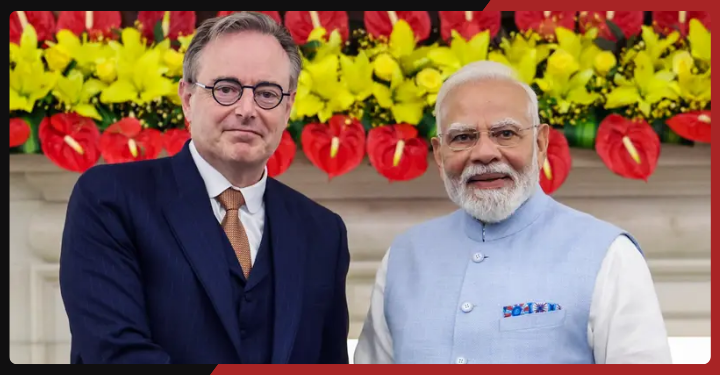
The global economic landscape is changing rapidly, and Belgian Prime Minister Bart De Wever believes India must play a central role in Europe’s future strategy.
During his India visit, De Wever spoke strongly about the dangers of economic dependence and acknowledged that Europe had been slow to understand the risks. He said India had recognised the problem earlier and that Prime Minister Narendra Modi had warned Europe about the consequences.
Now, Europe appears to be searching for stronger and more reliable strategic partnerships.
India is increasingly at the centre of that search.
De Wever emphasised the importance of building relationships based on trust, cooperation and mutual respect. His comments came at a time when global trade is being reshaped by geopolitical tensions, tariff disputes and concerns over supply-chain security.
For many countries, the question is no longer simply where goods can be purchased at the lowest price.
The question has become: who can be trusted as a long-term partner?
Europe’s growing concern about strategic dependency has pushed governments and businesses to rethink traditional economic models. Critical industries such as technology, semiconductors, energy and minerals are now seen not only as commercial sectors but also as matters of national security.
This is where India has gained increasing importance.
India offers Europe a major market, a large manufacturing base and an expanding technology ecosystem. It is also one of the world’s largest democracies and has developed relationships across different regions and geopolitical blocs.
De Wever’s comments suggest that Belgium sees India as much more than a trade destination.
The relationship is becoming strategic.
India and Belgium have agreed to expand cooperation across multiple important sectors. Trade, defence, clean energy, critical minerals, research and technology are among the areas receiving increased attention.
The two countries are also working towards greater investment cooperation.
This growing partnership is part of a larger shift in India-Europe relations.
Europe is attempting to reduce vulnerabilities created by concentrated supply chains. India, meanwhile, is expanding its manufacturing capacity and seeking deeper partnerships with global economies.
The interests of both sides are increasingly aligning.
De Wever’s recognition of India’s earlier warnings gives the partnership an additional political dimension.
It suggests that Europe is now willing to take India’s strategic concerns more seriously.
For years, India has argued for the importance of strategic autonomy and resilient supply chains. The country has attempted to develop domestic capabilities while maintaining partnerships with different nations.
The changing international environment has made this approach increasingly relevant.
Economic dependencies can become powerful tools during political disputes. A country that controls critical technology, raw materials or manufacturing capacity may be able to influence others.
European governments have become increasingly aware of this challenge.
De Wever’s message was that Europe does not want to be pushed around through economic dependence.
India faces similar concerns.
That shared understanding could provide the foundation for a stronger partnership.
The future of India-Europe relations may therefore be defined not only by trade volumes but by strategic cooperation.
Technology partnerships could become deeper.
Defence cooperation could expand.
Investment could increase.
Supply chains could become more diversified.
And India could become one of Europe’s most important partners in building a more resilient economic future.
Belgium’s Prime Minister has made Europe’s changing position clear.
India warned Europe earlier.
Europe may have realised the danger late.
But the search for a new strategic partnership has already begun—and India is expected to play a major role in it.
Journalist Details

Latest entries
 World NewsSeptember 5, 2026Belgium PM Calls India a Key Partner as Europe Rethinks Global Dependencies
 World NewsSeptember 2, 2026Trump Warns Iran of Stronger Action as U.S.-Iran Conflict Explodes Again
 Latest NewsAugust 24, 2026India’s Space Startups Get PM Modi’s Backing as Government Eyes Global Leadership
 World NewsAugust 20, 2026Trump Targets Iran’s Global Economic Lifelines With Sweeping New Threat